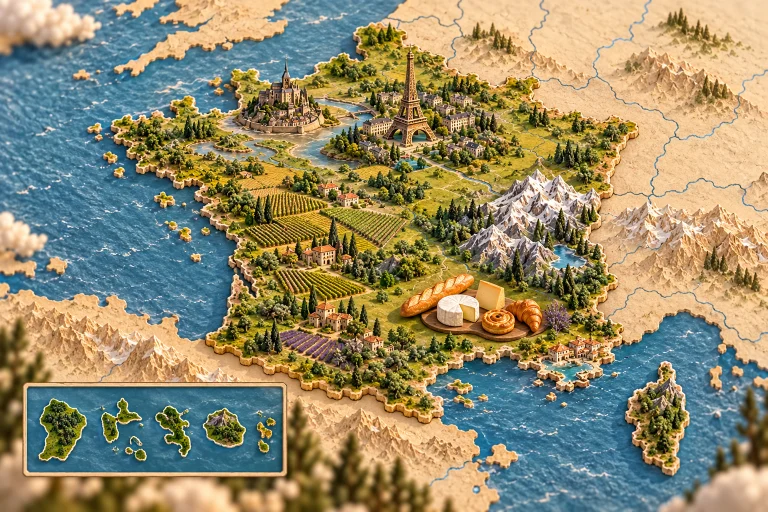
France combines a European mainland, Corsica and overseas territories across several continents. Languages, heritage, landscapes and food vary between regions; these living traditions extend far beyond Parisian symbols and include distinct island and overseas cultural histories. France is made up of eighteen regions across Europe, the Americas and the Indian Ocean. Mountains, rivers, islands, coasts and forests carry different languages, crafts and festivals. Cheeses, breads, wines, seafood, Creole kitchens, tropical fruit and Mediterranean dishes show the breadth of its food traditions. Useful starting points connect landscapes with cultural heritage: Eiffel Tower, Mont Saint Michel, Alps, vineyards. Food offers another way to explore, including bread, cheeses, pastries. These examples introduce selected traditions; they cannot represent every community, region or culinary practice in the country. Markets, workshops and everyday places help explain how skills are passed on, adapted and kept alive. Their stories reveal connections between local ingredients, seasonal celebrations and the people who prepare and share meals. On Kestufela, shared public places and contributions continue this overview with more specific discoveries. Choose a territory, section or interest to explore local perspectives, compare experiences and learn about the places behind familiar images.
Regions behind this diversity
Auvergne-Rhône-Alpes · volcanoes, Alps and skilled towns · mountain cheeses, ravioli and wines
Bourgogne-Franche-Comté · vineyards, Jura and watchmaking · Comté cheese, mustard and wines
Bretagne · ports, fest-noz and ancient stones · galettes, cider and seafood
Centre-Val de Loire · Loire river, gardens and castles · goat cheeses, rillettes and wines
Corse · maquis, polyphonic song and villages · brocciu, chestnuts and charcuterie
Grand Est · European borders, festive markets and glassmaking · sauerkraut, mirabelles and Champagne
Hauts-de-France · belfries, estaminets and shared memory · Maroilles, waffles and beer
Île-de-France · museums, crafts and the Seine · Brie, baguettes and pastries
Normandie · orchards, ports and Impressionist heritage · cider, Camembert and seafood
Nouvelle-Aquitaine · ocean, Pyrenees and Basque traditions · oysters, canelés, truffles and wines
Occitanie · Occitan language, rugby and stone cities · cassoulet, aligot, Roquefort and wines
Pays de la Loire · Loire, marshes and equestrian culture · Muscadet, brioche and Guérande salt
Provence-Alpes-Côte d’Azur · coves, villages and perfumery · olive oil, bouillabaisse and citrus
Guadeloupe · gwoka, carnival and Creole culture · accras, colombo, cocoa and rum
Martinique · bèlè, sailing and Creole heritage · accras, Creole sausage and agricultural rum
Guyane · rivers and Indigenous, Bushinengé and Creole cultures · cassava, couac, fish and tropical fruit
La Réunion · maloya, mountain cirques and mixed cultures · cari, rougail, vanilla and lentils
Mayotte · lagoon, Mahoran and Swahili traditions · coconut, cassava, fish and ylang-ylang
These examples connect each region’s cultures and cuisines; they cannot capture the full diversity of its people and practices.
“C’est pas faux” means exactly: “what you’re saying is not entirely wrong,” or, in other words, “I partly agree with you, without fully confirming it.” It is a very useful phrase when you want to acknowledge that an idea has some merit while keeping a little distance. Put plainly, you understand the intention, but you are not signing on the dotted line.
In everyday French, it can be rendered as: “you’re not wrong,” “that’s not completely false,” or “fair point.” It is an ideal expression for saying yes… but not too emphatically. It is often used to avoid a blunt refusal, with a touch of diplomacy and, depending on the tone, a hint of humour.
It is mainly used orally, in informal conversation, when someone puts forward an argument, observation, or explanation that more or less holds up. For example: “You say he arrived late because of traffic? That’s not wrong; there was a huge traffic jam.” Another example: “If we leave earlier, we avoid stress; that’s not wrong, and we save time too.”
As for its origins, the expression became established through use in informal speech in France, shaped by conversational habits, passed along from person to person, and carrying a distinctly local flavour. It is a small everyday phrase: simple, effective, and a little shrewd—like a polite way of saying, “I can’t contradict you, but I’m keeping an open eye.”
Type selected: Typical words.
Typical word: “c’est pas faux” belongs to the local vocabulary of the area and brings a regional flavour to everyday conversation.