



Stone Genius: Pont du Gard

 AI-generated
Article
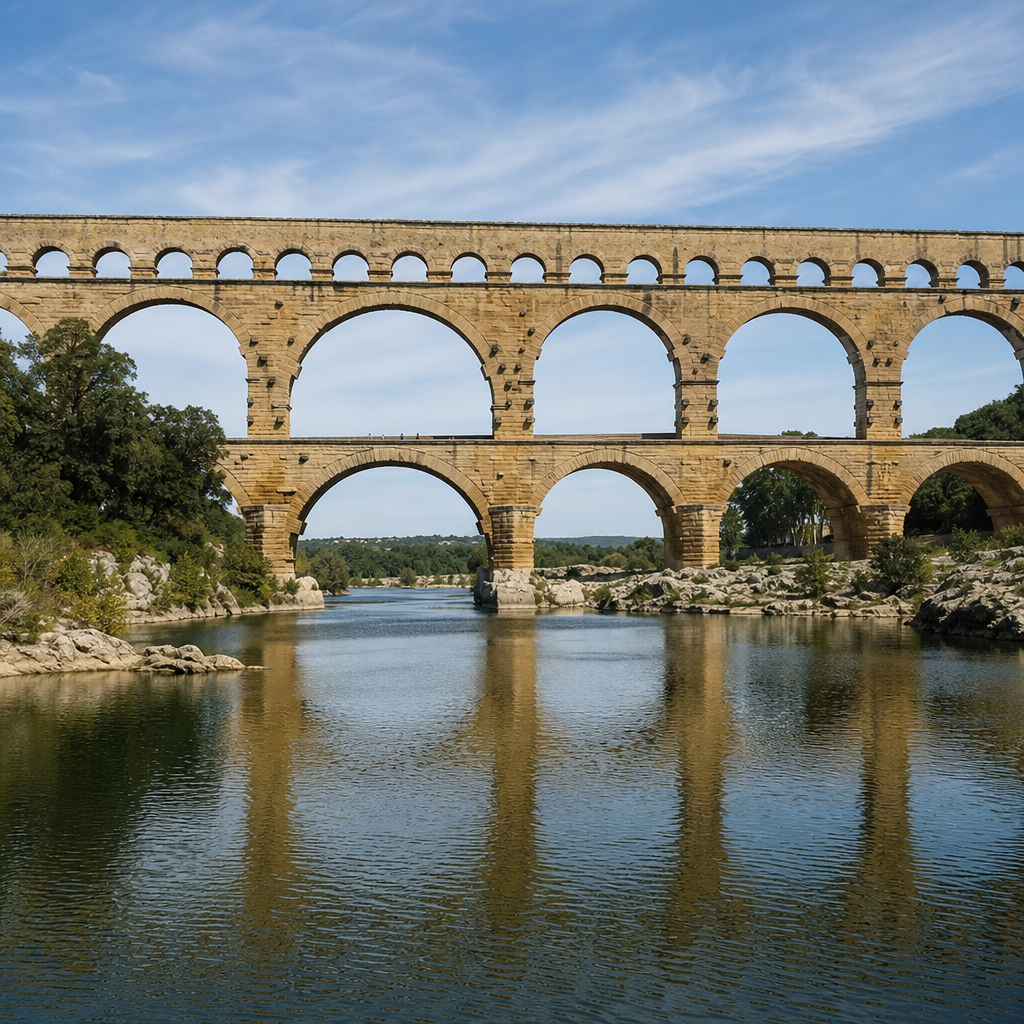
# Pont du Gard, Roman ingenuity above the Gardon I am ElsaNord, and some landmarks need no lengthy explanation to make an impression. The Pont du Gard is one of them. Spanning the Gardon at Vers-Pont-du-Gard, near Remoulins, between Uzès and Nîmes, this immense Roman structure embodies an idea turned to stone: carrying water over dozens of kilometres, with a precision and ambition that remain striking. The monument is a three-tier bridge built to carry an aqueduct. Probably constructed in the first half of the 1st century under the Roman Empire, it ensured the continuity of the aqueduct that brought water from Uzès to Nîmes. It is considered the tallest aqueduct bridge known from the Roman world and one of the most monumental examples of its engineering. ## Why make the detour The Pont du Gard is more than a spectacular ruin: it tells the story of a network, a use, and a long history of transformations. Originally, its purpose was entirely practical. Water flowed through the uppermost section of the structure, crossing the Gardon by way of its three rows of arches. The aqueduct is thought to have ceased operating at the beginning of the 6th century. Yet the bridge did not disappear with its original function. In the Middle Ages, the piers of the second level were cut back to allow road traffic to pass. This alteration remains a visible trace of how later generations repurposed the structure. The bridge’s exceptional architecture attracted attention as early as the 16th century and led to regular restorations. A road bridge was built alongside the monument between 1743 and 1747. The site therefore allows visitors to read, within a single landscape, the Roman legacy, medieval adaptations, and modern conservation efforts. Listed as a historic monument as early as 1840, the Pont du Gard has been inscribed on the UNESCO World Heritage List since December 1985. ## The best time The Pont du Gard is above all experienced through the eye: the layering of its three levels, the scale of its piers, its crossing of the Gardon, and the contrast between the stone and the surrounding landscape. A visit at a quiet time makes it easier to appreciate its proportions and its place within the valley. As traffic conditions and access arrangements may change according to the season or events, it is advisable to consult the site’s official information before setting off. ## Preparing your visit Taking the time to move a little away from the structure helps convey its scale. Up close, one notices the rhythm of the arches and the massiveness of the stones; from a distance, the aqueduct appears as a monumental line stretching from one bank to the other. The site is especially interesting for anyone wishing to connect a visit with the region’s ancient history: the bridge formed part of the aqueduct supplying Nîmes from Uzès. Keeping that destination in mind changes one’s contemplation of the monument: it is not an isolated structure, but a spectacular fragment of a larger Roman infrastructure. Check practical arrangements, accessible routes, and any restrictions with the official site before your visit. ## Access and landmarks The Pont du Gard lies in the Gard department of Occitanie, in the commune of Vers-Pont-du-Gard, near Remoulins. It spans the Gardon and is located not far from Uzès and Nîmes. On site, the landmark is unmistakable: its three tiers of arches cross the river in a valley landscape. Even for a brief stop, the structure leaves a lasting impression—that of a Roman construction whose technical function has never diminished its aesthetic power.
Information
Where: Vers-Pont-du-Gard — Occitanie