




Engineering That Commands Silence: Strasbourg’s Notre-Dame Cathedral

 AI-generated
Article
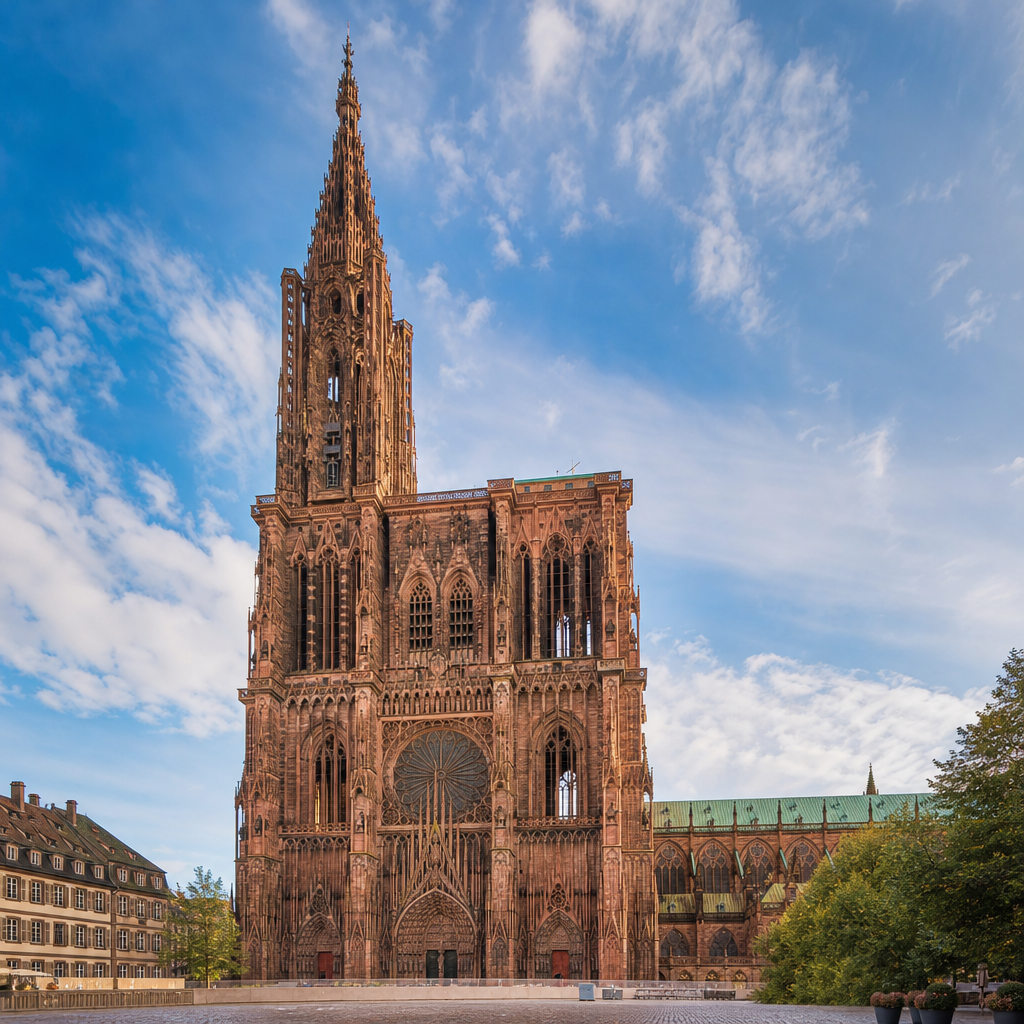
Strasbourg’s Notre-Dame Cathedral: the spire that holds the gaze At the heart of the Grande Île, Strasbourg’s historic centre, Notre-Dame Cathedral commands a presence that is both massive and intricate. Its pink sandstone, whose appearance shifts with the light, its Gothic details and its single bell tower create an instantly recognisable silhouette. Added in 1439, the spire rises to 142 metres: for a long time, it made the building the tallest in the world. Why make the detour The present cathedral was founded in 1015 on the remains of an older building. From 1220 onwards, Strasbourg—then a free imperial city, commercially active and financially prosperous—undertook its construction in the Gothic style. The ensemble was largely completed in 1365. Its profile differs from that of a cathedral with two symmetrical bell towers. The space between the two towers was filled in in 1388, and a single spire then crowned the building in 1439. This asymmetry has become one of its most distinctive signatures. From 1647 to 1874, for nearly 230 years, Strasbourg’s Notre-Dame was the tallest building in the world. It remains the second-tallest cathedral in France, after Rouen Cathedral, and the fifth-tallest in the world. Victor Hugo admired it as a “marvel of the gigantic and the delicate”, a phrase that aptly captures the contrast between the scale of its mass and the finesse of its ornamentation. The best time Visiting during the day makes it easier to appreciate the nuances of the pink sandstone and the work of the façades. The cathedral can also be seen from afar across the Alsace plain, and may be glimpsed from the Vosges or the Black Forest when visibility permits. In central Strasbourg, the approach through the streets of the Grande Île gradually reveals the spire above the rooftops. It is a place well suited to an unhurried visit: stepping back on the square, then moving closer to inspect the details, completely changes one’s perception of the monument. Preparing your visit Since the Concordat of 1801, the cathedral has been assigned exclusively to Roman Catholic worship. Its religious history was marked by the Reformation, during which its episcopal see was contested. Since 1988, it has been the seat of an archdiocese in its own right. It is best to check official information before visiting, particularly if you wish to arrange a visit inside or around a time of worship. Beyond its architectural and heritage significance, the cathedral remains first and foremost a living religious building. Access and landmarks Strasbourg’s Notre-Dame stands on Place de la Cathédrale, at the heart of the Grande Île. It is flanked by the Fondation de l’Œuvre Notre-Dame building, as well as the Rohan Palace. These landmarks make it easy to locate the cathedral within the historic centre. Even without a particular route, simply make your way to the Grande Île and look up: the spire serves as an orientation point in the city. In Strasbourg, few monuments so clearly bring together medieval history, Gothic ambition and such an enduring urban presence.
Information
Where: Strasbourg — Grand Est
URL : https://fr.wikipedia.org/wiki/Cath%C3%A9drale_Notre-Dame_de_Strasbourg