




Bukchon Hanok Village

 AI-generated
Article
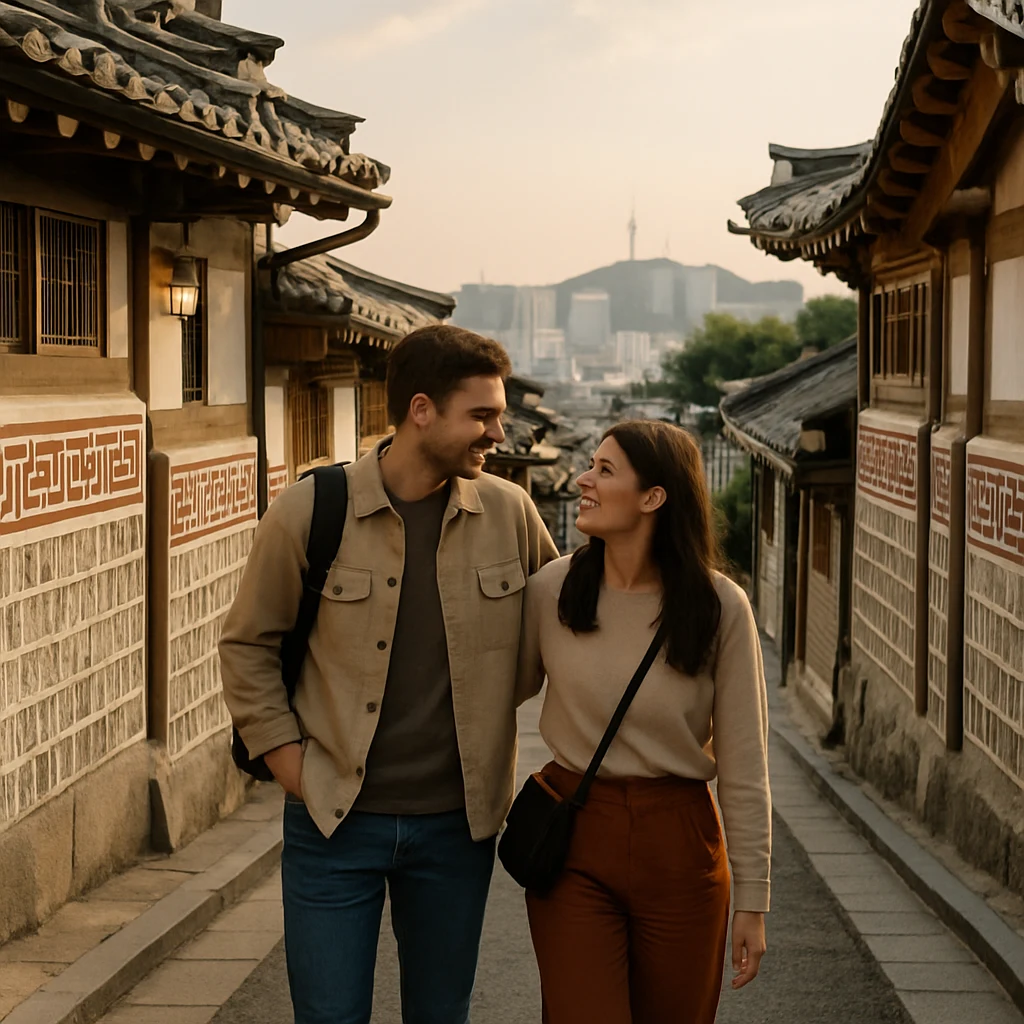
# Bukchon Hanok Village: Strolling Together Through Seoul’s Traditional Homes ## Description Bukchon Hanok Village invites you to slow down in the heart of Seoul, South Korea. Between palaces and hills, its lanes create a distinctive urban landscape punctuated by traditional Korean houses, known as *hanok*. Here, the appeal lies not only in any particular landmark, but in the walk itself: a sequence of passages, gentle slopes, rooftops and changing views around every corner. The neighbourhood feels like an interlude within the capital. Its façades preserve a more intimate atmosphere than Seoul’s major avenues, while the terrain lends depth to both the views and the route. This is not a frozen backdrop: Bukchon is a lived-in neighbourhood. That reality gives the visit its value, but also calls for a considerate and discreet approach. The simplest landmark from which to begin exploring is **Anguk**. From there, let the lanes guide you rather than following an exhaustive list of stops. The experience is best kept flexible: walk at an unhurried pace, observe the architectural details, then choose a quieter street when the atmosphere becomes too lively. ## Why Visit as a Couple Bukchon Hanok Village is especially well suited to exploring as a pair. The neighbourhood encourages an unhurried walk, ideal for quiet conversations and spontaneous pauses. Together, you can take the time to compare viewpoints, choose a route as the lanes unfold, or simply share the silence of an elevated passageway. The walk has a subtle charm: it is not about ticking off attractions, but about creating a moment at your own pace. One of you may notice a line of rooftops, while the other spots a gate, a courtyard, or the balance between the houses and the surrounding hills. This shared attentiveness turns a simple walk into a more personal travel memory. It is also a lovely stop for travellers wishing to see another side of Seoul. After the bustle of modern districts or the vast palace grounds, Bukchon offers a quieter transition. Its proximity to the palaces and hills reinforces the feeling of being between several eras and several urban rhythms. ## Best Seasons Bukchon can be explored whenever walking conditions suit you: above all, favour pleasant weather, as the visit is primarily experienced on foot through sloping lanes. Seasons that naturally invite long walks make it easier to take your time and enjoy the changing light across the traditional rooftops. Beyond the season, the time of day you choose matters most for comfort and tranquillity. As this is a residential neighbourhood, favour a measured approach and avoid unnecessarily extending your stay in quiet areas. As access conditions, local recommendations and possible restrictions may change, consult the official source before your visit. ## Practical Tips Bukchon is a living neighbourhood: the first rule is to **respect residents and quiet areas**. Keep your voice low, avoid noisy gatherings, do not linger in front of private entrances, and follow any signage on site. A respectful visit protects both the neighbourhood’s tranquillity and the quality of the experience for everyone. Wear suitable walking shoes, as the lanes and terrain are an integral part of the experience. Keep your route flexible as well: if a street seems crowded or particularly residential, head in another direction. Bukchon reveals itself better at a slow pace than in a rush. Do not infer opening hours, prices, available services or access rules from outdated information. For any variable details, check the latest information through the official **Visit Seoul** source: <https://english.visitseoul.net/>. ## Access and Landmarks The main landmark given is **Anguk**, a convenient starting point for reaching the lanes of Bukchon Hanok Village. Once in the area, make your way gradually among the traditional houses, bearing in mind that the neighbourhood lies between Seoul’s palaces and hills. To locate the area on a map, use the following coordinates: **37.582600, 126.983000**. They correspond to Bukchon Hanok Village in **South Korea**. Before setting out, check the official source for up-to-date access directions, any visitor guidance, and any information that may change.
Information
Where: Séoul — Corée du Sud